

Imagine it’s Tuesday morning, BTC is wobbling, and you need to move a margin position or retrieve a token from a connected wallet fast. You open a browser, type “OKX,” and pause: is this the centralized exchange, the Web3 wallet, the DEX aggregator, or all three? Which login will actually let you trade, stake, or interact with a DeFi protocol without losing access or running afoul of rules? That scenario reveals why myths about OKX persist: the platform packs multiple architectures under one brand, and conflating them leads to mistakes—lost time, wrong security choices, or compliance surprises.
This article untangles those confusions for US-based traders who want to log in to an OKX account, use the Web3 features, and understand the limits and trade-offs. I’ll correct common misconceptions, explain the mechanisms behind account types and verification, point out where things can break, and offer practical heuristics for fast, safe decisions in live markets.
Myth 1 — One Login Does Everything: Reality and the Technical Boundary
Myth: “Sign in once and you can trade on the CEX, control a self-custodial wallet, and execute cross-chain swaps seamlessly.” Reality: OKX offers both centralized account services (the exchange) and a non-custodial Web3 wallet. They are integrated in the user interface, but technically distinct. The centralized exchange account is an identity-bound service that requires Know Your Customer (KYC) verification (government ID plus a facial liveness check). That gives you access to spot, margin, derivatives, staking, NFTs, and custodial custody where OKX holds assets. The Web3 wallet is a self-custodial seed-phrase wallet that you control; it can be connected to the exchange interface but does not grant the exchange custody of those assets unless you deposit them.
Why that distinction matters in practice: if you lose a self-custodial seed phrase, OKX cannot restore it. Conversely, the CEX can freeze or remediate suspicious custodial accounts under AML rules. The mental model to hold: “CEX = identity + recoverability under rules; Web3 wallet = keys + responsibility.” This matters when speed or regulatory coverage is the priority—for example, margin calls on the CEX are handled by the exchange’s liquidation engine; a position managed via a self-custodial bridge may require different liquidity and has different risk of contract failures.
Myth 2 — Verification Is Optional for High-Value Trading
Myth: “You can trade large volumes without KYC on OKX.” Reality: KYC is mandatory to open an account on the centralized side and to use many features. For US users this is non-negotiable because of AML rules—expect to submit a government-issued ID and complete a live facial check. Mechanistically, KYC links an identity to account privileges: higher funding limits, derivatives access, and fiat onramps require stronger verification. The exchange uses KYC to manage counterparty risk and regulatory exposure; that’s not just paperwork, it’s a gating mechanism for features.
Trade-off: completing KYC gives you access and recoverability (customer support can act on a verified account), but it also ties your on-chain activity—if you deposit assets from a noncustodial address, the custodial ledger will still map those funds to your verified profile. If privacy is your priority, understand those trade-offs: move some holdings to a separate non-custodial wallet and treat it as distinct from your OKX identity.
How Login Security Actually Works — Mechanisms, Protections, and Failure Modes
Mechanisms: OKX uses mandatory two-factor authentication (2FA), military-grade encryption, and AI-driven systems to flag suspicious logins. For mobile users, biometric login is available which speeds access while preserving a second authentication factor in many cases. For high-value activity, hardware wallet integrations (Ledger, Trezor) are supported for the non-custodial wallet, which shifts the trust model from the exchange to your device.
What can fail: phishing remains the dominant external threat. Attackers mimic login pages, social-engineer 2FA codes, or trick users into approving malicious transactions on a connected wallet. Another failure mode is account lockout: if you lose access to the second factor and you are not properly backed up (for example, SMS-recovery can be vulnerable to SIM-swapping), regaining access involves identity checks that can take time—dangerous in a fast-moving market. Finally, if you use the non-custodial Web3 wallet and lose the seed phrase, access is permanently lost—no exchange recourse.
Feature Trade-Offs: Trading, Leverage, DEX Aggregation, and Staking
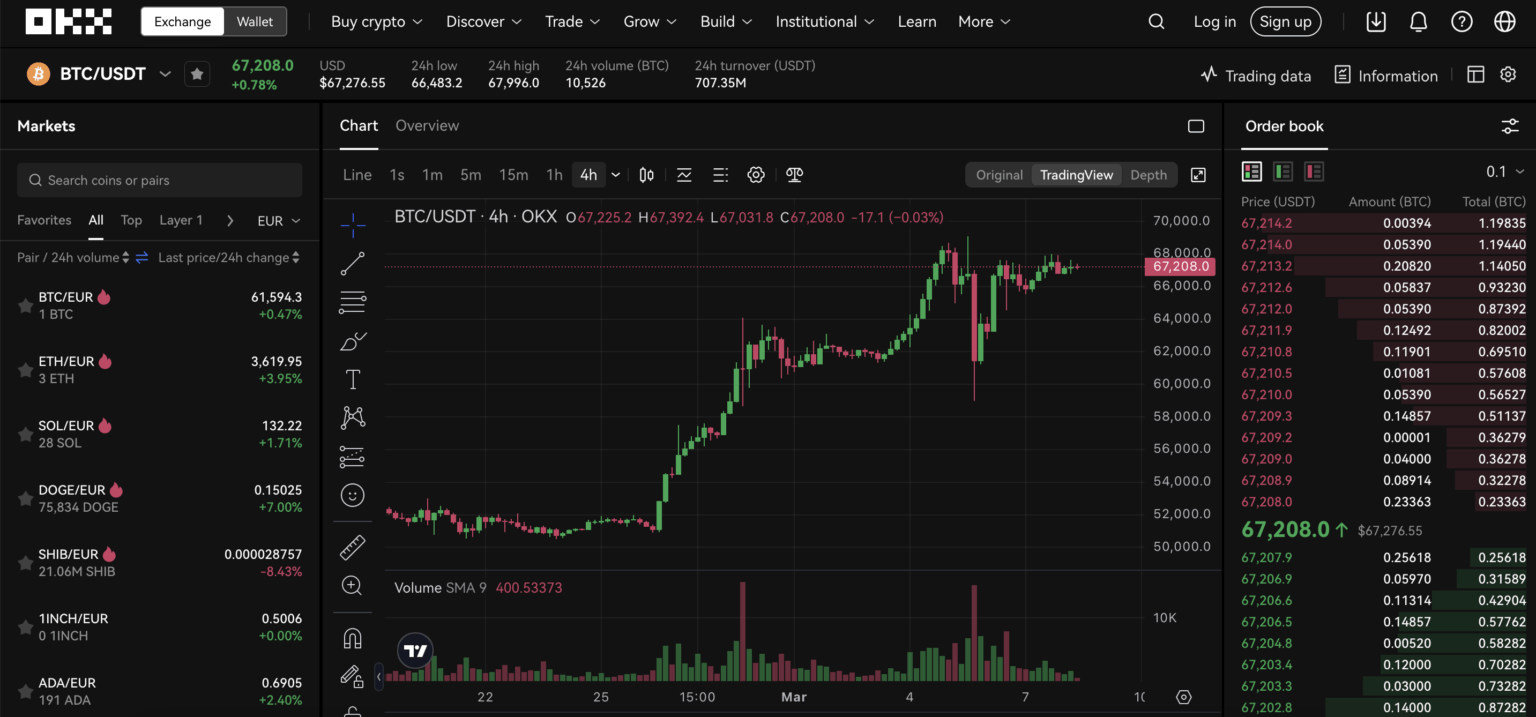
Understanding trade-offs helps you choose the right lane quickly. The CEX side supports spot trading, margin up to 10x, and derivatives (quarterly futures, perpetuals, options) with leverage up to 125x on certain products. That provides execution speed, deep order books, and advanced charting (TradingView) — valuable for active traders. But leverage multiplies risk: liquidation algorithms, funding rates, and counterparty exposure become central concerns. The Web3 side and the OKX DEX aggregator trade off execution guarantees for on-chain composability: you can route swaps through Uniswap and other pools to seek better prices, but slippage, front-running, and smart contract risk are real costs.
Staking and yield: OKX offers flexible and lock-up staking, and options like auto-compounding. These are useful for yield but come with lock-up restrictions and smart contract exposure if you choose DeFi farming. From a US-trader perspective, remember that yield-generating products may generate taxable events—staking rewards are often treated as income when received, and selling later creates capital gains. The decision framework: if you need liquidity and priority on recoverability, keep assets on the custodial CEX; if you want yield and composability, diversify into the non-custodial wallet but segment risk.
Operational Heuristics: How to Log In and Act in a Time-Sensitive Situation
Practical checklist for the scenario in the opening paragraph:
– If you need to execute a margin order or close a derivatives position, log in to your verified CEX account and ensure 2FA is available. Use the exchange interface (web or mobile) for fastest execution.
– If you must interact with a DeFi protocol or retrieve funds from a non-custodial wallet, use the browser extension or mobile wallet and double-check the contract address before approving transactions.
– If you keep both types of accounts, maintain separate operational practices: different passwords, distinct 2FA methods, and clearly labeled wallets for custody vs. self-custody.
For new users seeking quick access to the exchange login flow, follow the platform’s dedicated guides for sign-in and verification; for convenience, see this resource: okx login.
Heuristic: “If speed matters, prioritize the custodial route; if autonomy matters, prioritize the non-custodial route”—but maintain a portion of assets in each so you can act across scenarios.
Limits, Unresolved Issues, and What to Watch Next
Limitations and boundary conditions are important. OKX publicly states it keeps over 95% of user assets in cold, multi-signature wallets—this greatly reduces exchange-level theft risk, but it does not remove systemic risks: smart contract exploits in DeFi, macro liquidity shocks, or regulatory enforcement that limits certain trading pairs. For example, this week OKX delisted several spot pairs (RSS3, MemeFi, GHST, RIO, SWEAT), a routine housekeeping action intended to maintain trading quality. Delistings signal the exchange’s ongoing risk management but can strand holders of low-liquidity tokens.
Open questions and signals: regulatory pressure in the US remains the most consequential external factor. Changes in policy or enforcement priorities would primarily affect the CEX side (what products are offered, KYC thresholds, or allowable derivatives). Technically, the integration of CEX services and Web3 wallets raises questions about data flows between custodial and non-custodial domains—what metadata is stored, how provenance is tracked, and how proof-of-reserves interacts with on-chain transparency. Monitor three signals: product delistings, audit disclosures of the DEX aggregator contracts, and changes to KYC/verification workflows.
Decision-Useful Takeaways (A Simple Framework)
1) Identify the objective: speed (close a position), yield (stake), or autonomy (self-custody). Use the custodial CEX for speed and recovery; use the Web3 wallet for autonomy and composability.
2) Match verification to exposure: complete KYC for capital-intensive CEX trading; keep small, separate non-custodial wallets for experiments and DeFi access.
3) Harden logins: prefer hardware wallets for large non-custodial holdings; enable app-based 2FA and avoid SMS where possible; never paste seed phrases into a browser or give them to support.
4) Monitor liquidity and listings: delistings remove execution routes. For thin tokens, assume wide spreads and potential inability to exit during stress.
FAQ
Do I need to complete KYC to use OKX’s Web3 wallet?
No. You can create and use the self-custodial OKX Web3 wallet without submitting KYC because the wallet is key- and seed-based. However, to use OKX’s centralized exchange services (fiat onramps, derivatives, custodial spot/margin trading), KYC is required. Treat the two as operationally separate: one is identity-bound, the other is key-bound.
Can I use biometric login on the OKX mobile app and still keep strong security?
Yes. Biometric login (fingerprint or face recognition) is a convenience layer that typically sits alongside mandatory 2FA. For routine access it is safe, but for high-value transfers use additional safeguards: hardware wallets for non-custodial keys or manual confirmation steps for large withdrawals from custodial accounts.
What are the real risks of using the DEX aggregator inside OKX instead of a direct DEX?
The DEX aggregator routes trades across liquidity pools to optimize price and gas. This can reduce slippage compared with a single pool, but it exposes you to multi-contract execution paths, cross-chain bridge risk, and nonce/ordering issues. Aggregators can mask which pools are used, so vet the contract and monitor gas fees; in fast markets even an optimized route can suffer slippage or sandwich attacks.
If OKX stores 95% of assets in cold storage, am I free from exchange risk?
Cold storage greatly reduces the chance of custodial theft, but it doesn’t eliminate systemic risks. Risks that remain include operational errors, regulatory seizure, insolvency scenarios, and losses on the exchange’s balance sheet. Proof of Reserves provides transparency about on-chain backing, but understanding legal and operational protections in your jurisdiction remains necessary—especially for US-based traders.
Final practical note: separate your roles. Be explicit about which wallet you will use for trading, which for staking, and which for experiments. That mental separation—paired with strong login hygiene and a clear understanding of KYC boundaries—reduces mistakes when markets move fast. No single platform removes all risks; your job as a trader is to allocate assets and procedures to the right trust model, then adapt as the platform and regulations evolve.